His name was Gusney and according to legend he was the first person to send humans to the island of Wa'ab. Long before time was recorded the story goes, Gusney and four other supernatural Spirits sprang into being from a fresh water well located in the area now known as Tho'long, Colonia. One day, Gusney left his netherworldly companions on the island of Wa'ab (now known as Yap) and headed for unexplored lands. He sailed in a simple log canoe, propelled only by his hands, the wind, and the endless flow of the Pacific's waves.
Many moons passed and Gusney came upon a human family from the ancient place called Malaya. He liked them and sent them on to Wa'ab to let the other Spirits know of his whereabouts. Later he met another couple from India and sent them to Wa'ab as well. This couple, named Wan and Rayina, and a daughter of the first family, Ruliya, made Wa'ab their permanent home and, according to legend, are the ancient forebears of the Yapese people.
Anthropological theories about Yap's settlement are not inconsistent with local legends. The most reliable estimates suggest that Yap was settled over 3,500 years ago by seagoing voyagers migrating eastward in primitive loglike canoes from either Indonesia or the Philippines.
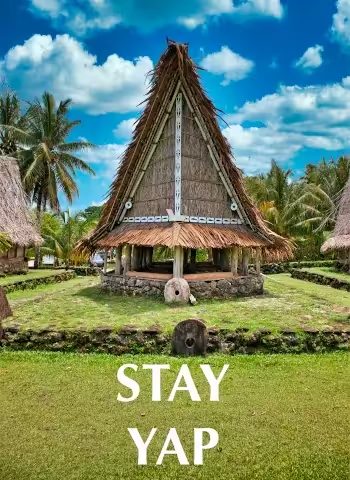
The ancient Yapese empire was a large, powerful, and highly organized society. At the empires peak, the central islands of Wa'ab may have had a population of more than 50,000. Huge meeting houses, stone amphitheaters, and Men's Houses dotted the shorelines. Inland majestic family houses sat atop raised stone platforms called "dayif," and their thatched peak roofs jutted out between coconut palms over an intricate winding network of stone paths.
Further from the sea were rows of carefully tended gardens where women toiled daily to harvest the taro, yams, and other hearty foods that complemented each day's catch of reef fish. Just a little farther back were ceremonial Women's Houses where young women came of age and were instructed in the art of beauty and taught the stories and dances of earlier generations.
The village was the basic political unit of the Yapese empire and was highly stratified. Rules of behavior were strictly governed by rank, class, gender, occupation, and age. At the head of each village, or village section, was a triumvirate of chiefs who were responsible for making decisions and organizing village projects.
Each village was allied with other villages based on sometimes byzantine traditional ties and short term political objectives. Villages sought to enhance their status at the expense of other communities. Villages were divided by rank, a distinction often wrongly characterized as being caste-like (the rank of a village was not static and often changed as a result of success or failure in war). At the top of the order were seven paramount villages led by the three villages of Teb, Tomil; Gachpar, Gagil; and Balebat, Rull. Further complicating the complex social order was a matriclan system and two competing island wide alliances called "Banpilung" (side of the chiefs) and "Banpagel" (side of the young men).
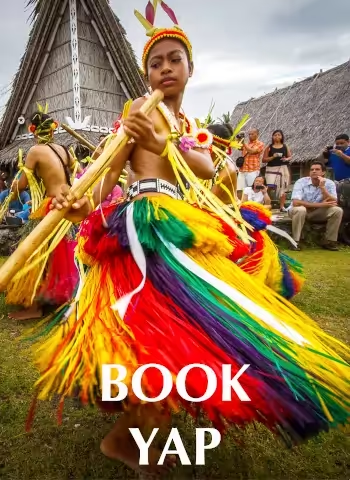
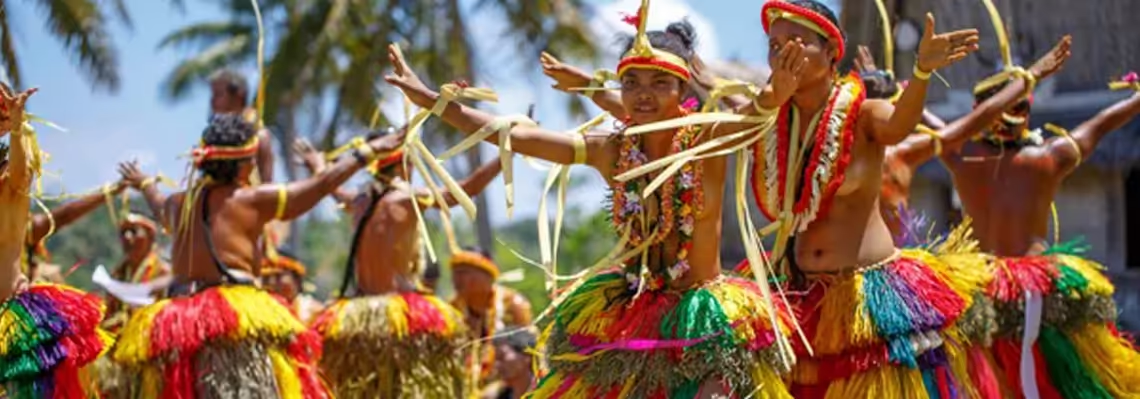
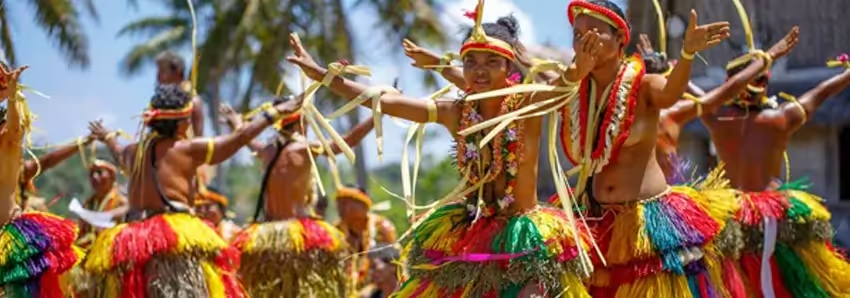
Competition took place in other forms as well. Villages staged elaborate celebrations and dances for other villages called "mitmits" to showcase their talent and communal wealth. The young boys, who lived in Men's House, periodically staged ritualized raids on other villages to capture a beautiful young woman. Once kidnapped, the woman was expected to live in the Men's House and serve the village's young men as a "mispil," somewhat akin to a combination of concubine and housekeeper. The navigators of select villages competed with other villages to make the treacherous passages to Palau and back to quarry the crystalline stone money so highly valued throughout Wa'ab.
The Yapese empire stretched beyond the islands of Wa'ab proper through the village of Gachpar, Gagil. Partly because of their material abundance relative to the Outer Islands and partly because of the respect they commanded due to their fierce warriors and allegedly powerful magic, the Yapese were able to demand and receive tributes from the Outer Islands. Each year, canoes loaded with gifts of lavalavas, coconut rope, and other valuables made pilgrimages to Yap to pay homage, seek continued protection, and offer valuable goods such as wood for canoes and the ritual spice tumeric.
According to local legends the first foreign ship to come upon the main islands was anticipated before it arrived. At that time the core islands were comprised of the four high volcanic islands now called Yap proper, and a fifth island named Seepin, thirty-five miles to the Northeast. The people of Seepin had a vision of a terrible white-skinned people coming in a huge craft to the islands and called a meeting of all the chiefs to discuss what the local response should be to the impending arrival of the foreign "ghosts." The discussion raged on and on for many months, with some chiefs favoring a wait and see approach while the leaders of Seepin strongly urged that all of the islands use their magic to sink beneath the sea in order to flee from the outsiders. The debate dragged on and the chiefs seemed paralyzed and unable to make a final decision.
In due time the decision was made for them. The foreign ship was coming, just as the leaders of Seepin had forewarned. As the mast of the ship crossed the horizon, the people of Seepin broke off the talks and tearfully bid farewell to their friends from the other islands. Determined to avoid contact with the outsiders they called upon their greatest magicians and sank the entire island beneath the waves - like the legendary Atlantis - and were never seen again.
Sometime later when the first ship to anchor at the central islands arrived, perhaps still thinking of their departed brothers from Seepin, a canoe of local warriors from the remaining islands went out to greet the ship and through sign language communicated their desire to have the captain come ashore for discussions. As they boarded the warrior's canoe, the ship's captain pointed towards the shore and asked the name of the nearby land masses. Thinking that the Captain was pointing at a canoe paddle held by a navigator in the bow, the warriors responded proudly - Yap. The name was duly recorded by the Captain and it stuck, so to this day the islands of Wa'ab are known to the outside world as Yap, or "canoe paddle!"
|