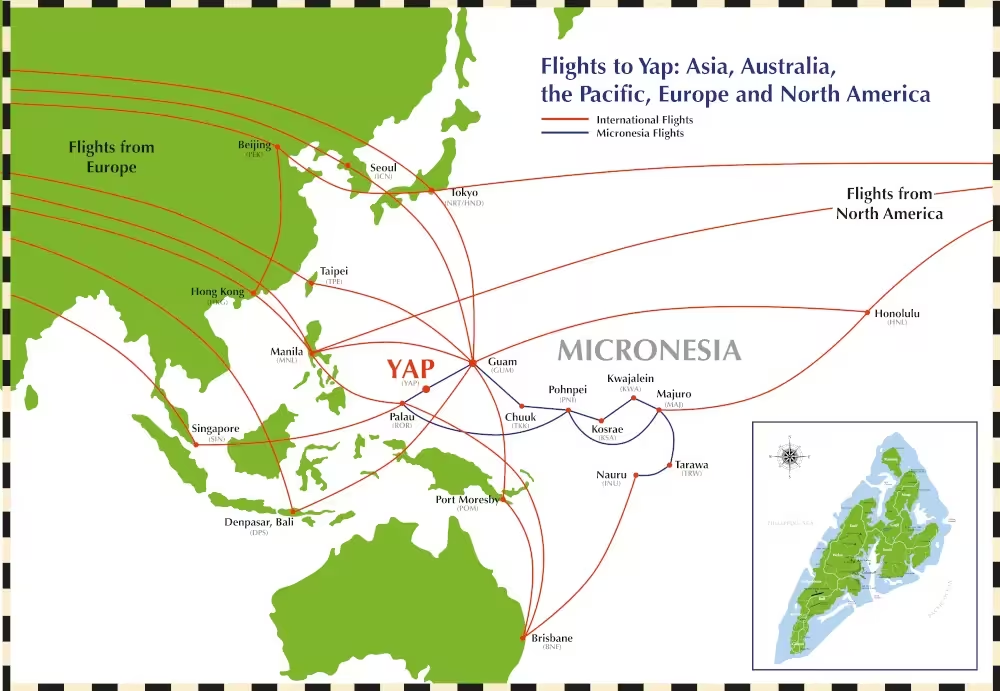
1500 B.C.(?) - Yap populated by migrators from Eastern Indonesia or the Philippines. Archaeologists are still studying the migration issue and have not conclusively determined when or how the islands of Yap were settled. The arrival of settlers may have occurred as far back as two thousand B.C.
1525 - On October 1, the Portuguese explorer Diego Da Rocha arrives in the islands of Yap, probably Ulithi, and stays for four months. Over the next two centuries more than twenty other explorers and traders of Spanish, British, Dutch, and American origin passed through the Yap Islands.
1731 - Father Juan Cantova and Father Victor Walter bring Catholicism to the island of Mongmong, Ulithi. After several months Father Walter returned by ship to Guam. Shortly thereafter Cantova and his party were massacred, perhaps by local priests opposed to the new religion.
1800 to 1860 - Intermittent trading between Yapese and Europeans for Behe-de-mer (Sea Cucumbers). Britain's Andrew Cheyene was perhaps the most well known trader during this period. Outer Island residents began making regular voyages of their own during this time to Guam and the Marianas.
1818 - One hundred Outer Islanders from Lamotrek sail to Guam and a year later establish a colony in Siapan.
1869 - Germans establish first permanent trading station, Godeffory & Son, under management of Alfred Teten. By 1874, its holdings included 3,000 acres of land, a cotton plantation, and ship repair operation.
1871 - David Dean O'Keefe, an American Sailor on a pearl diving expedition aboard the Belvidere, is shipwrecked on Yap and rescued by the Yapese people. He was later taken to Hong Kong on a German trading ship.
1872 - O'Keefe returns as skipper of a Chinese junk named Catherine (after his American wife) and begins his famous trade of Stone Money for copra and Beche-de-mer.
During this period, the largest pieces of Stone Money were quarried in Palau using iron tools. These pieces are commonly referred to as "O'Keefe's Money" and are not as highly valued as the money brought to Yap by traditional canoes.
1874 - Spain proclaims sovereignty over Yap.
1876 - Germany sends a warship to Yap to map the island and protect German interests.
1880's - Yap established as a commercial center of Caroline Islands. During this period Yap serves as the major regional source of copra, is home to four trading companies, and is a coaling station for Spanish steamers.
1885 - The Spanish/German feud reaches climax. On August 21, two Spanish ships arrive with a governor, two priests, soldiers, convict laborers, horses, water buffalo, cattle, and stones for a governor's house and a mission. Four days later the German gunboat Iltis drops anchor and a small party races ashore to hoist a German flag and a claim to the island - just prior to the formal colonization ceremony the Spanish are planning.
1886 - Pope Leo XIII settles the feud between Germany's Bismarck and Spain's King Alfonso. The Pope awards Yap and the other Caroline Islands to Spain, but grants Germany and other nations commercial rights. Spain sets up a small garrison and begins building the first of six Catholic churches.
1899 - Spain sells Yap and the remainder of Spanish Micronesia to Germany for $4.5 million. First German delegation includes a Governor, secretary, doctor, police chief, and eleven Malay police.
1900 to 1906 - Disease ravages Yap. The population declines from 7,464 to 6,641 with influenza and leprosy being the main killers.
1901 - O'Keefe disappears at sea. Tagrenga Canal opens.
1902 - Germans select one boy from each municipality for training as medical officers and establish municipal medical stations.
1903 - Germans open islands first hospital near Tarang Island.
1905 - German communications station finished, linking Yap with Guam and Shanghai.
1908 - Last Spanish leave Yap.
1909 - Phosphate mines open at Angaur (Palau) and Germans recruit 98 Yapese to work there.
1910 - Pohnpeians who revolted against Germans are exiled to Yap and Palau.
1914 - World War I begins. British shelling destroys German communications center. Japanese Expeditionary Squadron occupies the island on October 7, in a bloodless takeover.
1919 - Secret treaty agreement between Japan and Britain to guarantee Japanese control over all Pacific islands north of the Equator is announced to the world at the Treaty of Versailles.
1920 - Rapid Japanese settlement begins.
1921 - Japan and United States sign treaty recognizing American rights to use Yap's cable station.
1922 - Japanese civilian administration begins under League of Nations mandate. Tattooing banned.
1925 - Typhoon destroys nearly all homes on Yap.
1935 - Japan leaves League of Nations. The fortification of Yap begins.
1938 to 1939 - Military preparations intensify. Yapese are forced to work in labor gangs. Nickel mine opens in Gagil. Strip mining for bauxite and phosphate on Yap and Fais.
1941 to 1942 - World War II begins. Japanese build lighthouse in Gagil and intensive gardening begins in a large part of southern Yap.
1944 - Allies begin bombing Colonia, the Japanese airfield at the southern end of the island and the airfield under construction in Tomil.
|